

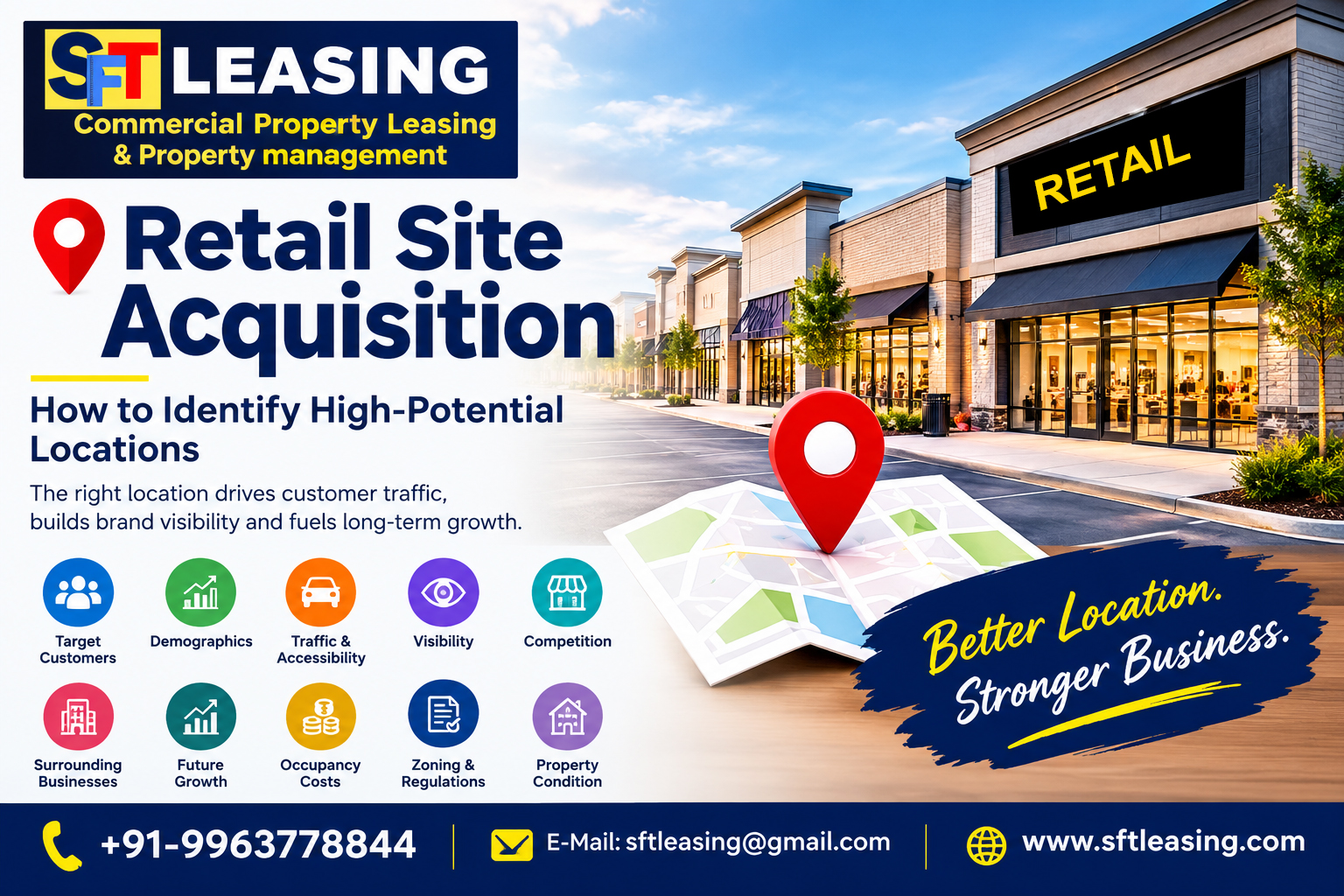
Retail Site Acquisition, How to Identify High-Potential Locations
Choosing the right location is one of the most important decisions a retail business can make. A great retail site can attract more customers, improve brand visibility, support long-term growth, and create stronger sales opportunities. On the other hand, a poorly selected location can lead to low foot traffic, high operating costs, and disappointing business performance.
This is where retail site acquisition becomes essential. By evaluating locations strategically and analyzing factors such as demographics, accessibility, competition, visibility, and future development, businesses can identify sites with strong growth potential.
What Is Retail Site Acquisition?
Retail site acquisition is the process of identifying, evaluating, negotiating, and securing a suitable property for a retail business.
The process typically involves:
- Defining location requirements
- Identifying potential markets and properties
- Studying customer demographics
- Evaluating foot and vehicle traffic
- Analyzing competitors
- Assessing accessibility and visibility
- Reviewing rental or purchase costs
- Conducting property due diligence
- Negotiating lease or purchase terms
- Finalizing the site
The objective is not simply to find an available property, but to find a location that supports the retailer’s business model and long-term objectives.
Why Location Matters in Retail
Retail success is closely connected to where a store is located. Customers generally prefer businesses that are convenient, accessible, visible, and situated near areas they already visit.
A strategically selected site can provide:
- Higher customer traffic
- Better brand exposure
- Greater convenience for customers
- Improved sales potential
- Stronger competitive positioning
- Opportunities for future expansion
Location decisions can also influence staffing, logistics, delivery operations, marketing costs, and overall profitability.
1. Understand Your Target Customer
Before searching for a property, clearly define your target customer.
Consider factors such as:
- Age group
- Income levels
- Lifestyle
- Shopping habits
- Family size
- Employment patterns
- Spending behavior
- Preferred shopping locations
For example, a premium fashion retailer may benefit from an affluent shopping district, while a convenience-oriented retailer may prioritize residential neighborhoods with easy access and frequent daily traffic.
Understanding your customer helps narrow the search to locations where demand is most likely to exist.
2. Analyze Local Demographics
Demographic data can reveal whether a particular market matches your target audience.
Study:
- Population size
- Population growth
- Household income
- Employment levels
- Age distribution
- Residential density
- Consumer spending patterns
A growing population can indicate expanding demand, while a strong concentration of your target demographic can make a location particularly relevant.
However, demographics should be considered alongside actual retail demand and competitive conditions rather than viewed in isolation.
3. Evaluate Foot Traffic and Vehicle Traffic
Traffic is an important consideration for many retail businesses.
Depending on the business model, evaluate:
- Pedestrian traffic
- Vehicle counts
- Peak traffic periods
- Weekend traffic
- Nearby public transportation
- Parking availability
- Traffic flow and turning access
A high-traffic location is not automatically the right location. The traffic should also consist of people who are relevant to your target customer base.
4. Assess Visibility and Accessibility
A store needs to be easy for customers to find and reach.
Look for properties with:
- Strong street visibility
- Clear signage opportunities
- Convenient entrances and exits
- Adequate parking
- Good pedestrian access
- Nearby public transportation
- Minimal access barriers
A highly visible property can reduce the effort required for customers to discover the business and may strengthen brand awareness.
5. Study the Competitive Landscape
Competition can provide valuable information about a market.
Identify:
- Direct competitors
- Indirect competitors
- Complementary businesses
- Recently opened stores
- Store closures
- Retail clusters
- Major shopping destinations
Competition is not necessarily a negative factor. In some cases, businesses located near complementary retailers can benefit from shared customer traffic.
The key is understanding whether the market has sufficient demand and whether your business can differentiate itself.
6. Examine the Surrounding Businesses
The businesses surrounding a retail property can influence customer traffic and the overall attractiveness of the location.
Consider nearby:
- Restaurants
- Supermarkets
- Shopping centers
- Gyms
- Banks
- Offices
- Entertainment venues
- Residential communities
- Schools and institutions
Complementary businesses can create a stronger retail ecosystem and encourage customers to make multiple stops during a visit.
7. Consider Future Development
Retail site acquisition should not focus only on current conditions.
Research planned and proposed:
- Residential developments
- Commercial projects
- Roads and infrastructure
- Shopping centers
- Transit improvements
- Office developments
- Public facilities
A location that is currently developing may offer opportunities for future growth. At the same time, construction projects can create short-term access or visibility challenges, so timing and development schedules should be carefully evaluated.
8. Compare Occupancy Costs
A location can have strong commercial potential but still be unsuitable if occupancy costs are too high for the business.
Analyze:
- Base rent
- Common area maintenance charges
- Property taxes
- Insurance
- Utilities
- Maintenance expenses
- Security deposits
- Fit-out costs
- Renovation expenses
Instead of evaluating rent alone, calculate the total occupancy cost and compare it with projected sales and operating margins.
9. Review Zoning and Property Regulations
Before committing to a site, verify that the property can legally support your intended business use.
Review:
- Zoning classification
- Permitted retail activities
- Signage regulations
- Parking requirements
- Operating restrictions
- Licensing requirements
- Building regulations
- Local development restrictions
Early due diligence can help prevent costly problems later in the acquisition process.
10. Evaluate the Property’s Physical Condition
The location may look attractive from a market perspective, but the physical property also needs to meet your operational requirements.
Inspect:
- Building condition
- Floor area
- Ceiling height
- Electrical capacity
- Plumbing
- HVAC systems
- Loading facilities
- Storage space
- Customer entrances
- Parking
- Fire and safety systems
Estimate any required improvements before making a final financial decision.
11. Use a Location Scoring Framework
Retailers can make site selection more objective by creating a consistent evaluation framework.
For example, each potential location can be assessed based on:
| Factor | Key Consideration |
|---|---|
| Customer Demographics | Does the local population match the target market? |
| Traffic | Is there sufficient relevant customer traffic? |
| Visibility | Can customers easily see the store? |
| Accessibility | Is the property easy to reach? |
| Parking | Is convenient parking available? |
| Competition | What competitors operate nearby? |
| Co-Tenancy | Are complementary businesses nearby? |
| Occupancy Cost | Does the financial structure fit the business? |
| Growth Potential | Is the surrounding market expanding? |
| Property Condition | Can the space support operations efficiently? |
Using the same criteria for every site makes it easier to compare alternatives objectively.
12. Conduct a Thorough Site Visit
Data and market research are important, but visiting a property in person can reveal details that online research may miss.
Visit the site at different times, including:
- Weekday mornings
- Weekday afternoons
- Evening periods
- Weekends
- Peak shopping hours
Observe customer behavior, traffic patterns, parking availability, neighboring businesses, visibility, noise, and accessibility.
13. Negotiate the Right Lease Terms
Once a promising property has been identified, the lease structure becomes an important part of the acquisition process.
Depending on the situation, retailers may negotiate:
- Rent
- Lease duration
- Rent escalation
- Rent-free periods
- Tenant improvement allowances
- Renewal options
- Exclusivity clauses
- Maintenance responsibilities
- Signage rights
- Expansion options
- Early termination provisions
A favorable location can become less attractive if the lease terms create excessive financial or operational pressure.
14. Work With Retail Real Estate Professionals
Retail site acquisition often involves multiple factors, including market research, property analysis, negotiations, legal considerations, and financial evaluation.
A commercial real estate professional can help businesses:
- Identify suitable properties
- Analyze local markets
- Compare potential sites
- Evaluate property economics
- Conduct market research
- Identify hidden risks
- Negotiate lease terms
- Coordinate the acquisition process
Professional guidance can help retailers make decisions based on both current market conditions and long-term business objectives.
Common Mistakes to Avoid
Retailers should be careful to avoid common site-selection mistakes such as:
Choosing Based Only on Low Rent
A low-cost property may have poor visibility, limited traffic, or weak customer demand.
Ignoring the Target Customer
A busy location is not necessarily valuable if the surrounding customer profile does not match the business.
Looking Only at Current Conditions
Future development can significantly change a market over time.
Underestimating Fit-Out Costs
Renovations, signage, equipment, and infrastructure can substantially increase the total investment.
Failing to Study Competitors
Ignoring nearby competition can result in unrealistic sales expectations.
Skipping Due Diligence
Zoning, access, property condition, and lease restrictions should be reviewed before committing.
Final Thoughts
Successful retail site acquisition is about finding the right balance between customer demand, accessibility, visibility, competition, costs, property suitability, and future growth.
The strongest location is not necessarily the busiest or most expensive property. It is the location that aligns with the retailer’s target customers, operating model, financial capacity, and long-term growth strategy.
By combining market research, demographic analysis, site visits, financial evaluation, and professional real estate advice, businesses can make more informed decisions and improve their chances of selecting a high-potential retail location.