
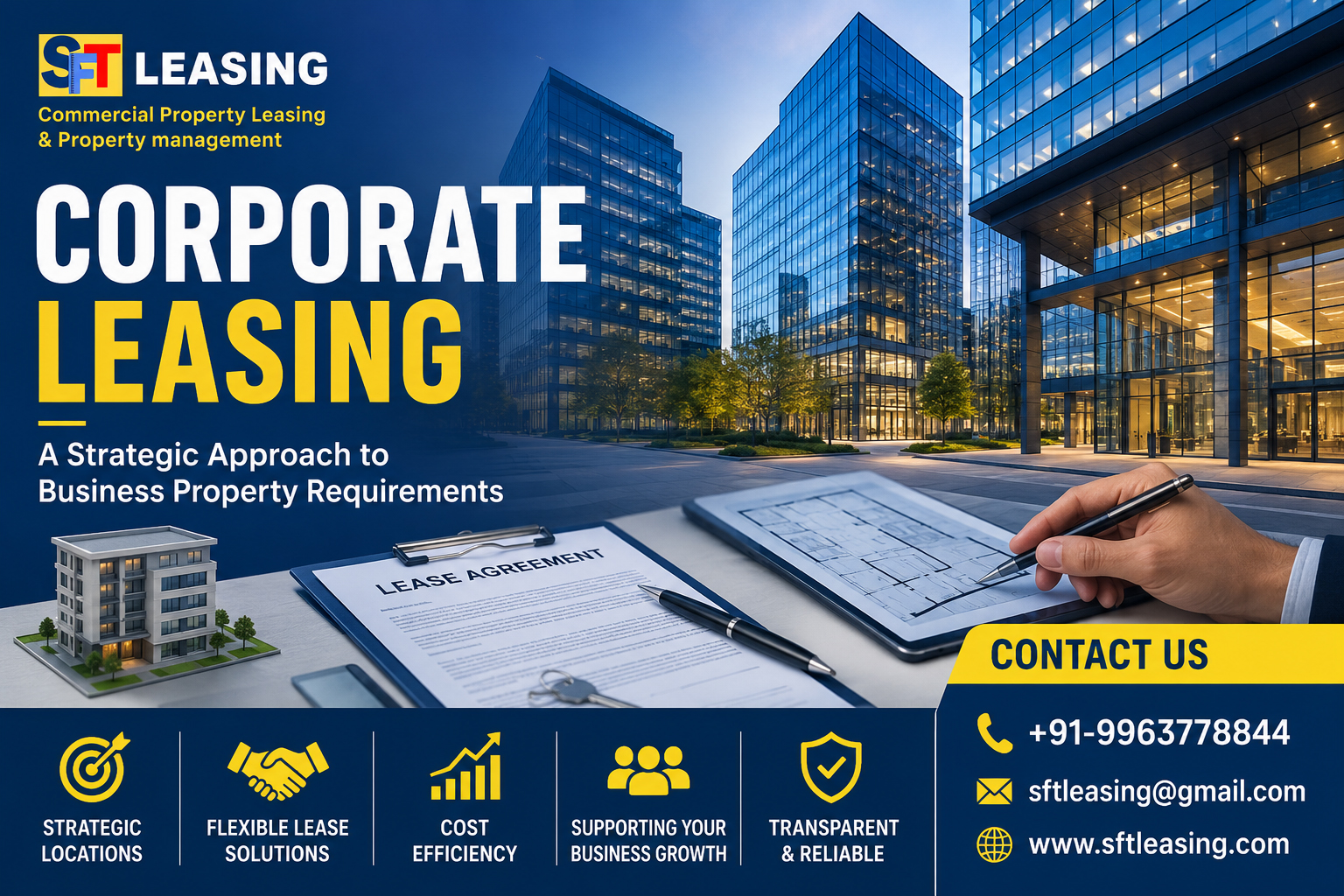
Corporate Leasing, A Strategic Approach to Business Property Requirements
Corporate leasing is more than simply finding an office and signing a rental agreement. For growing businesses, the right commercial property can directly influence productivity, employee satisfaction, brand image, operating costs, and long-term growth.
A strategic approach to corporate leasing helps businesses identify the right location, property type, space requirements, lease structure, and commercial terms while reducing unnecessary costs and risks.
What Is Corporate Leasing?
Corporate leasing refers to renting commercial property for business operations under a structured lease agreement. Depending on the organization’s requirements, this may include corporate offices, coworking spaces, business centers, retail premises, warehouses, industrial facilities, or other commercial properties.
Unlike short-term property rentals, corporate leasing generally involves careful planning around business objectives, budget, employee requirements, operational needs, and future expansion.
Why Corporate Leasing Requires a Strategic Approach
Choosing a business property without proper planning can create challenges such as excessive rental costs, inconvenient locations, insufficient workspace, limited expansion opportunities, or unfavorable lease conditions.
A strategic leasing approach allows businesses to:
- Optimize occupancy and rental costs
- Choose locations that support business objectives
- Improve employee accessibility and convenience
- Create a professional environment for clients and employees
- Plan for future business expansion
- Negotiate better commercial terms
- Reduce operational and property-related risks
Key Factors to Consider in Corporate Leasing
1. Define Your Business Requirements
Before searching for a property, clearly identify your requirements. Consider the number of employees, departments, meeting rooms, reception areas, storage requirements, parking, technology infrastructure, and other operational needs.
A detailed requirement analysis helps avoid paying for unnecessary space or choosing a property that cannot support your operations.
2. Choose the Right Location
Location is one of the most important factors in corporate leasing. A strategically located property can improve accessibility for employees, clients, suppliers, and business partners.
Consider:
- Connectivity to major roads and public transportation
- Proximity to clients and business hubs
- Availability of parking
- Surrounding commercial infrastructure
- Neighborhood profile and business environment
- Future development potential
3. Evaluate Total Occupancy Costs
Rent is only one component of the total cost of occupying a commercial property. Businesses should evaluate maintenance charges, utilities, parking costs, taxes, fit-out expenses, security deposits, common-area charges, and other applicable expenses.
Understanding the complete cost structure makes it easier to compare different properties accurately.
4. Consider Flexibility and Future Growth
Business requirements can change quickly. A company may expand its workforce, establish new departments, or change its operational model.
When negotiating a lease, consider whether the property provides options for expansion, renewal, relocation, subleasing, or flexible space arrangements. Planning for future requirements can prevent costly relocation later.
5. Review Lease Terms Carefully
The lease agreement should be examined carefully before signing. Important terms may include:
- Lease duration
- Security deposit
- Rent escalation
- Lock-in period
- Renewal conditions
- Maintenance responsibilities
- Termination clauses
- Notice period
- Fit-out permissions
- Subleasing provisions
Professional legal and real estate advice can help businesses understand obligations and negotiate appropriate terms.
The Role of Corporate Real Estate Advisors
Corporate real estate advisors can simplify the leasing process by helping businesses understand market conditions, identify suitable properties, evaluate options, negotiate commercial terms, and coordinate the transaction.
Their market knowledge can also help companies avoid common leasing mistakes and make decisions based on both current requirements and long-term business objectives.
Benefits of Strategic Corporate Leasing
A well-planned corporate leasing strategy can deliver several benefits:
Cost Efficiency: Businesses can control occupancy costs and avoid unnecessary space.
Better Productivity: A well-designed and accessible workplace can support employee productivity and collaboration.
Professional Brand Image: The right office location and environment can strengthen the company’s image among clients and stakeholders.
Operational Flexibility: Flexible lease structures can help businesses adapt to changing requirements.
Long-Term Planning: Strategic property decisions support sustainable business expansion.
Common Corporate Leasing Mistakes to Avoid
Businesses should avoid selecting a property based solely on rental price. A low-cost property may become expensive if it has poor connectivity, inadequate infrastructure, limited parking, or insufficient space.
Other common mistakes include:
- Not calculating total occupancy costs
- Ignoring future expansion requirements
- Failing to negotiate lease terms
- Overlooking building infrastructure
- Not reviewing termination and renewal clauses
- Rushing the decision without comparing multiple properties
Conclusion
Corporate leasing should be viewed as a strategic business decision rather than simply a property transaction. The right commercial space can support productivity, employee satisfaction, customer relationships, brand positioning, and future growth.
By clearly defining business requirements, evaluating locations and total costs, reviewing lease terms, planning for future needs, and seeking professional guidance when required, companies can make smarter and more sustainable property decisions.
Looking for the right corporate property for your business? A professional commercial real estate advisory team can help you identify suitable options, evaluate properties, and negotiate leasing solutions aligned with your business goals.